Showing posts with label John Folse. Show all posts

Tuesday, September 18, 2012

What a Month!


The week after Rick and I returned from our invigorating dinner at the James Beard House, we prepared for the launch of Lunch service back in New Orleans.
Restaurant R’evolution began offering Lunch in early August with many standouts from the Dinner menu, so now you don’t have to wait to have Corn and Crab Cappuccino or Death by Gumbo!  And we've decided to offer our house-made, bite-sized treats prepared by Chef Erin, normally available at dinner, also at Lunch in the month of September.  We’ll present Fall-flavored bites in our jewel boxes (see picture on right) after each lunch service with our compliments.  In addition, I’ll be hiding a Restaurant R'evolution gift card in one gift box each week of the month and giving lunch guests complimentary parking in the Royal Sonesta Hotel garage.

Back in August while Rick was off in Chicago and Los Angeles, I was crossing the big pond to the 2012 Olympic Games where I had the privilege to cook for Team USA and represent the Louisiana contingent in BP’s “Spirit of the Gulf” promotion, a series of special events for Team USA showcasing the Gulf Coast’s unique culture, distinctive attractions and our best-tasting seafood. Along with seven of the best chefs from Alabama, Florida, Louisiana, and Mississippi, we prepared buffet-style dinners for over 1000 people each day for three days and a 200-person lunch with cooking demonstrations.  I was excited to serve my ultimate Louisiana crab cakes with a roasted red pepper cream sauce.  My friend and Galatoire’s Executive Chef, Michael Sichel, also showcased Louisiana crab with the restaurant’s classic dish: Crabmeat Maison.  We had prepared all of our recipes at my manufacturing plant in Donaldsonville and shipped the food via UPS to London, chilled at minus 40 degrees. The good news: every ounce of seafood tasted like it had been swimming in the Gulf that morning! The logistics of getting that much Gulf seafood to London took trust and a whole lot of prayers.  


While I wasn't able to sneak away to watch the Games, I was in London on the Glorious 12th, the opening of the grouse hunt.  Bringing a copy of my wild game cookbook to Rules, one of the oldest and game-focused restaurants in Europe, was like my gold medal for the trip.

At the end of August, Rick and I were honored to help organize the Fourth Annual Dining By Design fundraiser at White Oak Plantation in Baton Rouge benefiting neighbors at the Cypress Springs Mercedarian Prayer Center.  The culinary extravaganza at The Crowne Plaza Hotel on Sunday, August 26th was prepared by ten national and Louisiana renowned chefs with tablescapes designed by eight local interior designers and florists.  Patrons feasted on four-course dinners with crawfish boil risotto, root beer glazed veal shank, white chocolate bread pudding and other delicious dishes.  This year we extended the event by adding Chilin’ & Grillin’ the day before as an opportunity to meet and greet the participating celebrity chefs and designers and tour the Prayer Center to learn more about the mission of the Sister Dulce Foundation.  It was a wonderful success, and we’re thankful for the support of everyone involved.  Rick and I had the most fun bringing the visiting chefs on some unique Louisiana field trips, like shrimping and fishing in the Gulf and swamp tours!

This weekend we launched Sunday Brunch at Restaurant R’evolution.  Every Sunday from 10:30 a.m. to 2:00 p.m. we’ll offer a “r’evolutionary” brunch of Crawfish Crepes, Duck Confit and Eggs, Grillades and Gravy Spanish Style, and more twists on classic dishes!  We invite you to make reservations at 504-553-2277 or on Opentable.com.
And November may seem far away, but Rick and I are really looking forward to bringing a taste of Restaurant R’evolution to Blackberry Farmthe exclusive 9200 acre luxury hotel and resort in Tennessee.  If you'd like to attend our Cooking School & Epicurean Event celebrating Blackberry Farm's 35th anniversary please email reservations@blackberryfarm.com.  We've both been once before, but never together…
The Farm at Blackberry Farm, TN
-John

Monday, June 4, 2012

Video Tour: A Restaurant R’evolution Sneak Peek

We couldn’t be more excited to officially open the doors at Restaurant R’evolution today at 5 p.m.! In anticipation of our public debut, we invited our friends from Bringing it Home into the kitchen a few weeks ago for an exclusive, behind-the-scenes tour, and wanted to share it with you.
Follow Chef Folse as he leads you through the action-packed back line and catch the R’evolution team preparing for the opening – from braising pork shanks, to bubbling soups and gumbos, to a snapshot of our sweet treats...and beyond!

We hope to see you soon!
Chefs Folse and Tramonto

Tuesday, August 30, 2011

It's Been a Long Time Coming

Demolition and progress
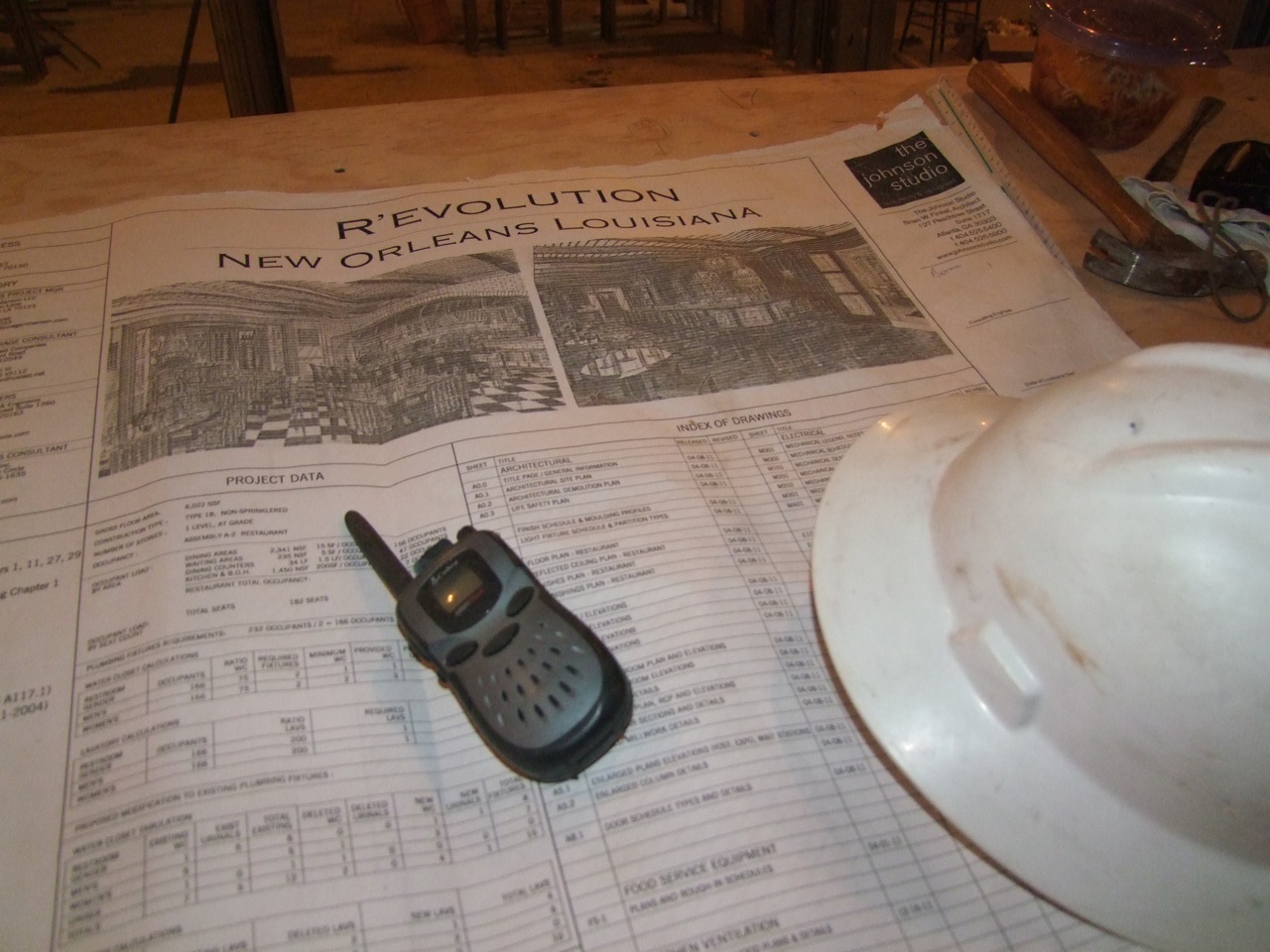
After signing our contract to conceptualize, design and build Restaurant R’evolution at The Royal Sonesta Hotel in New Orleans, Rick and I felt confident that we would be firing up the ranges and wowing guests at Bienville and Bourbon streets by January 2011. Well, as with most, if not all, construction projects, delays are inevitable.  Add to the mix that we’re tearing down and building up in the historic French Quarter and you begin to get a glimmer of life these past months.  I’m sure Neil Armstrong’s walk on the moon could not have been more difficult.
Exposed brick work over doors

For all of you who have been involved in construction projects, whether building a home, expanding a business or revamping a summer getaway, you know the challenges and delays in the world of construction.  It’s easy to analyze the process after the fact, but not as easy while going through the experience.  From owners and designers to purveyors and marketing specialists, there are a lot of moving parts and different entities who ultimately bring the project to fruition.  Yes, construction is no “I Dream of Jeannie” moment where fingers are snapped and all is completed within seconds in perfect fashion, smiles radiating from every face.  But, all’s well that end’s well and we are moving forward and with great exuberance as R’evolution rises from the slab. 


7 months 'til delivery

Now, we’re entering the exciting phase of construction.  The equipment we’ve talked about for months, the rooms we’ve envisioned in our minds and seen as renderings on large-sheets of paper; everything is now tangible and touchable.  We’re still in our first trimester, but we’re only 7 months from delivery.  The new opening date is hovering around March 1, 2012.  This is just after Mardi Gras and about 8 weeks before Jazz Fest, a great time to be in NOLA.  But, don’t mark your calendars yet! The date could be sooner, but we can say with confidence that it certainly won’t be later.
One of the highlights of working on a project like Restaurant R’evolution is the architect and designer.  Bill Johnson, of The Johnson Studio in Atlanta, has designed more than 500 of the best known restaurants in the business, both nationally and internationally. It’s amazing to see just how passionate he is about his work when he walks into the space.  Our contractors and builders have taken his incredible design and are working diligently to breathe life into the concept.
Understanding the vision!
The entire Sonesta organization, from the Sonnabend family in Boston to Royal Sonesta Hotel President Al Groos in New Orleans and his team, could not be more supportive, and like us, are eager for the opening night!  Our growing restaurant team is just as excited to fire up the stoves, set the tables, decant the wine and open the doors to welcome guests.  


Under way!

Rick pulls up a seat in Bar R'evolution

So, stay tuned! And visit the blog often, because from now until opening night, R’evolution will come to life before your eyes.

- John

Thursday, April 7, 2011

Bringing a Bite to the Big Apple…Swamp-Style

Chef Folse and The "Taste of the Bayou" Food Truck
I have been amazed at the huge success of Swamp People. Whether I’m talking to folks from Canada or Illinois, their first comment is about the program and how much they love it. I was approached a few weeks ago about going to New York City to promote the second season premiere of the program. Of course, I said “yes,” grabbed my camouflage chef jacket and headed north. My task: serving swamp delicacies to New Yorkers from the History® channel’s “Taste of the Bayou” food truck.

Crowds gathered to sample the swampland delicacies
The experience was a remarkable celebration of Louisiana cuisine and swampland culture. I climbed aboard our “swamp on wheels” and started dishing out alligator sauce piquante, mallard duck and smoked wild boar sausage gumbo, Louisiana red beans and rice with smoked nutria sausage, Louisiana crawfish étouffée, venison jambalaya and fricassee of swamp rabbit. I have to hand-it to New Yorkers. They were amazingly game to taste anything from the swampland of Louisiana. Over the four-day promotion (March 28 – 31) more than 13,000 free servings were handed out from the “Taste of the Bayou” food truck at prominent locations near Grand Central Station, Bryant Park, Penn Station, the Financial District, the Port Authority, Union Square and Chelsea.

I also had the opportunity to serve at a number of private tastings for executives of A&E Television Networks, Time Warner, Universal McCann, Initiative, Mindshare, Targeteast and ZenithOptimedia. I can assure you, these board rooms were a long way from the bayou.

Beware of Gator
I was thrilled to help promote the second season of Swamp People. The program was the best original series premiere ever on History® and ranked number one in its time period versus all television across key male and adult demographics. The second season premiered last week and can be seen every Thursday at 9 p.m. ET / 8 p.m. CT. Swamp People is drawing so much interest nationally and internationally that it’s quickly becoming a fabulous way to recruit visitors to Louisiana. So, come on down, get a taste of the bayou, and soon, you can eat with us, too, at Restaurant R’evolution. What? Of course, gator is on the menu!

Friday, February 25, 2011

R'evolution on the Road: Los Angeles

Chefs Folse and Tramonto with their Louisiana team
For the second straight year I have been invited to prepare the “Only in Louisiana Brunch” for the Grammy Awards in Los Angeles. This year I was happy to introduce Chef Rick Tramonto to the participants as well as our Louisiana team including Chef Jay Kimball and Chef Fred Heurtin.

The brunch marked the first time Rick and I participated in a national event of this scope since creating Home on the Range, our restaurant development company. The event was held at the Millennium Biltmore Hotel, the original home of the Oscars.


The “Only in Louisiana Brunch” has quickly become one of the “must attend” Grammy events. Rick and I even had an opportunity to interview Kermit Ruffin, a Louisiana Grammy nominee for his Treme soundtrack.

Sauce Piquante Bayou Lafourche on
Griddle Cakes
Dishes such as seafood gumbo, crawfish étouffée, chicken sauce piquant, shrimp rémoulade, white chocolate bread pudding with Bourbon sauce and Pontchatoula strawberries on powdered sugar-coated beignets as well as oysters on the half shell were featured on the menu.

One of the high points of this trip was the day Rick and I spent at Mission San Gabriel Arcángel in San Gabriel, CA, a suburb of L.A. Of particular interest to us were the gardens where we saw the “mother vine” of the California wine industry.

Mission San Gabriel Arcangel
Also on display were the original wine-making equipment for claret, which was made from zinfandel grapes, as well as a white wine made from Muscat. We held oranges from genetically authenticated trees that were brought by Spanish missionaries and planted on this site. To our amazement the cactus were fruiting during our visit. Apparently, cactus fruit was a prominent food at this early mission. And, the olive trees were spectacular.


Salmon dish at Bouchon Restaurant

Obviously, on trips like this we dine at restaurants owned and operated by the “best of the best” in our industry. We began our “food experience” with a casual lunch at Mozza where everything from pizza and pasta to roasted bone marrow and Brussels sprouts were served. And, we sampled every dessert on the menu. From there it was dinner at Bouchon. After beginning with soup, we enjoyed a smorgasbord of offerings including frog legs, pork belly, salmon,  French-roasted chicken and of course, an array of desserts that were to die for. We went on a guided tour of the Viking kitchen and prep areas. What a magnificent facility! Lunch at Spago was incredible followed by an evening at Bazaar, which was the perfect culminating meal on our “culinary voyage of discovery.


Chefs in the Garden of San Gabriel Arangel
Events like this enhance our partnership and camaraderie, and allow us to explore other worlds of cuisine. At the same time it allows us to showcase our cuisine in places people only hope to be seen. We look forward to our next culinary adventure!
-JF


For more photos from Chef Folse's Trip to LA and updates on the Restaurant R'evolution, please visit www.facebook.com/RestaurantRevolution.

Friday, February 18, 2011

Join the R’evolution Online, and Win!

We wanted to say a big ‘thank you’ to all of our readers for following us on this amazing journey. We’re pouring our hearts into Restaurant R’evolution, and we can’t wait to share it with all of you later this year.
Recently, we launched two new ways to follow the R’evolution online. Our official Facebook page www.facebook.com/RestaurantRevolution is up and running with pictures and behind-the-scenes video.
Restaurant R’evolution is also on Twitter at www.twitter.com/RevolutionNOLA. Follow us for the latest updates and lots of fun surprises as we countdown to the opening.
Now for the juicy details: We are launching the first of monthly Twitter contests on Tuesday, February 22. A few hints: This first contest will be a trivia question, the answer to which can be found right here on this blog. Please help us spread the word and gain more followers by retweeting our contest post and taking part in the fun!
Thanks for taking this culinary journey with us. Viva la R’evolution!

Friday, February 11, 2011

Culinary Journeys

Chefs Tramonto and Folse announcing their new partnership.
The partnership between Chefs John Folse and Rick Tramonto is one that began out of a mutual admiration, and was cemented by a shared history shaped by hardship but nurtured by food. Both chefs grew up, figuratively and literally, in the kitchen. In this Q&A, they talk about the culinary beginnings that ultimately made them the men – and the chefs – they are today. In addition to being award-winning chefs, John Folse and Rick Tramonto are acclaimed authors. Folse’s The Encyclopedia of Cajun & Creole Cuisine and Tramonto’s forthcoming memoir Scars of a Chef offer a more in-depth look into the chefs’ personal and culinary histories.


What is your earliest memory involving food and cooking? 
John Folse: I can’t even remember a time when I wasn’t involved in food and cooking.  As children, my mom and dad made us an integral part of the kitchen.  Each one of my five brothers and two sisters were doled out tasks according to their skill level.  As a young child I remember fetching sweet potatoes from a cupboard, one in each hand, and passing them on to an older brother for peeling and slicing.
My fondest memories are of the Sunday family gatherings where the men cooked.  Often over a hundred extended family members were in attendance. The conversation and education discovered at these Sunday dinners influences everything I do today.  Cooking has indeed always been a part of my life. After all, I grew up in Cajun Country.
Rick Tramonto: My parents and grandmothers were very blue-collar people but well-educated cooks. On the weekends we’d have lots of family over and everyone had to pitch in and do their part.
My earliest cooking memory is rolling meatballs with my Grandma Adeline. I must have been around five at the time, taking meat from a huge bowl, learning how to roll them into balls then placing them on the sheet tray. In my house, cooking wasn’t just an “only on the weekend” thing. We didn’t eat food out of boxes, or eat foods that were pre-frozen. We made everything from scratch.

What’s the first dish you learned how to cook?
Chef Folse
JF: I always loved Dirty Rice, which is rice cooked with small pieces of chicken liver or giblets. (Find a recipe for Dirty Rice from Chef Folse here). For a young boy living in the swamps of Louisiana “dirty rice” was not only a staple on our table, but a dish that was fun and easy to make. 
Mixing dark chicory coffee with scalded milk to create café au lait for breakfast was probably the first “dish” I ever created.  But without a doubt, it is dirty rice that I remember best as the first real dish I ever cooked.  I was probably seven years old. 
RT: Cooking wasn’t something that I took to right away, but it was always a part of my childhood. It was almost like a chore, whether it was making ravioli or roasting whole chickens. I guess the first “dish” I remember making was minestrone soup. I remember being really young – maybe eight – and learning how to make that for my family.

How would you describe your journey in the culinary world?
JF: I began my journey in cooking at the apron strings of family and acquaintances in St. James Parish, Louisiana. That love of local cuisine and culture inspired my passion to cook and share the uniqueness of our area.  Like all young culinarians, there were huge obstacles along the way: social distractions, lack of commitment, void of patience and an unwillingness to simply listen. After discovering that this was not a path to success, the pendulum swung to total obsession and a desire to absorb all things culinary, from ingredients to global technique. During my 30-year journey, this fabulous world of cooking has taken me on visits to cook for Presidents and Popes, produce food television and build a multi-faceted food company ranging from restaurants to food manufacturing and even publishing.
RT: My journey to cooking was an unconventional one. I left high school in 1977, and needed to find a job. Most people in Rochester, where I’m from, got a job at a gas station or became mechanics. But I wanted to cook because that was what I was most familiar with.
Luckily, I had a great opportunity to interview for a new restaurant opening in town: Wendy’s Old Fashioned Hamburgers. I had never heard of the restaurant, it was the first franchise for the city. When I filled out the application, I remember leaving the “Education” boxes blank. The manager I interviewed with asked me why I had done that, and I told him I hadn’t finished high school. They basically said, “Hey kid. We’re going to give you a chance.”
After working in Rochester, I realized that if I wanted to do this cooking thing for the rest of my life, I was going to have to learn as much as I could, and to do that, I would have to start apprenticing.
What do you feel was the biggest obstacle you had to overcome in establishing yourself as a chef?
Chef Tramonto

JF: The greatest obstacle that I had to overcome was a fabulous culinarian by the name of Chef Paul Prudhomme. Paul was a giant in the kitchen and was considered the father of Cajun cooking. When he created his now legendary blackened red fish, the world took note of Cajun Country and its cuisine. It was at this time that many Louisiana chefs tried to take advantage of the culinary wave established by Chef Paul. 
But most of the media content wanted to hear what Paul had to say rather than the young chefs coming up the “Bayou.” It became apparent to me that if I wanted to break out with my own style, I could bring Cajun to the world. Soon, I had opened promotional Louisiana restaurants from Hong Kong to Taipei and from London to the Soviet Union – the first opening of a foreign restaurant in the USSR prior to its fall. I even fed the Holy Father, Pope John Paul II, in Rome. 
RT: The biggest obstacle I faced in my culinary career that I had to overcome was being uneducated. It went beyond not finishing school or not knowing European languages. I didn’t know how to read. I wasn’t able to follow recipes; everything I learned had to be hands-on. But I have a photographic memory, so once I learned a dish, I was able to make it again myself. Personally, I had to overcome an addiction to drugs and alcohol. Having to focus and refocus and enter rehab to clean up my life.

When you were first starting out, who was your greatest culinary influence?
Chefs in the Restaurant R'evolution
test kitchen
JF: My great uncle Paul Zeringue, whom we referred to as “Nonc Paul,” was the cook to emulate. Even today at family gatherings, his name is passed around the dinner table more often than a bowl of rice dressing. 
Professionally, it had to be Chef Fritz Blumberg, a German chef who first recognized the culinary talents of this young South Louisiana cook. He was from Munich, arrived in Pittsburgh to work for the Mellon family, and eventually found his way to Baton Rouge as corporate chef for the hotel where I happened to be employed. I was mesmerized by his talent, and for reasons I still don’t know, he was inspired by the flavor and ingredients of our South Louisiana culinary scene. He needed to know more about our food, and I needed to learn everything there was to know about classical cuisine, so he became my mentor. We were friends until he passed away in 2008.
RT: My first culinary influences were my family, my grandmother Adeline in particular. From there, my appreciation is to the people who mentored me, who wouldn’t normally let a guy like me through the back door of their kitchen. People like Alfred Portale and Pierre Gagnaire, who helped me hone my technique and helped me articulate my thoughts on food onto the plate.
Now, John has become a huge influence of mine. Working with John has taken cooking to the next level for me because he brings rich history and depth to our company. He takes me places I wouldn’t have gone before.

Wednesday, January 19, 2011

'Tis the Season For Birds on the Wing


Ducks at dusk, Creole, LA.


In the R'evolution kitchen, we've begun work on the "Wild Game" portion of the menu, which is inspired by dishes from my childhood.

When I grew up we knew months not by the calendar, but by what was in season. It wasn’t September or the beginning of autumn; it was dove season and the start of deer season. November meant quail, squirrel and rabbit seasons. Snipe season was December and the New Year brought geese, ducks and coots.
 

Duck hunting in Louisiana.
It’s duck season now in Sportsman’s Paradise. Located at the apex of the Mississippi Flyway, Louisiana is home to some of the best waterfowl hunting in America. Our coastal wetlands, marshes, rivers and lakes are home to mallards, pintail, teal, white fronted geese and snow geese. In Louisiana, waterfowl hunting is a passion…some would say a birthright.


Hunting in Louisiana is generational.
I remember as a young Cajun boy, laying on my back looking up the sight of a 410 barrel at a sky blackened with birds. Lying beside me looking upward were my five brothers, all steady at the aim, great shots, who effortlessly seemed to bring down whatever bird was in their sight.

Not me. I couldn’t hit the side of a barn. It was then that I realized once and for all that I was not a hunter. I wasn’t destined to harvest the wild game; I was meant to cook it. So, I became a chef. I came from a long line of great hunters. I don’t know how many generations of grandfathers preceded the two that I knew, but I’m sure just as they were hunters, those unknown great-grandfathers taught them the skill as well. Naturally, my father was the best of the best. He knew the swamp like no other and was as comfortable there as he was on our front porch.


Chef John Folse and Cajun Escoffier Lee Roy Sevin, Cocodrie, LA.
Our home was filled with ingredients from the swamp floor pantry. I vividly recall trying my best to hide the contents of our old Frigidaire ice box from visiting friends, because it was filled with wild things including heads, feet, feathers and furs, while most of theirs contained domesticated meats such as beef and pork destined for the table. Little did I realize how blessed the Folse family actually was. In fact, we wanted for nothing, because the swamp floor was indeed the richest of all pantries and one an aristocrat could only hope for.

My culinary education in the art of preparing wild game delicacies came at the hands of the “Escoffiers” of Cajun Country. At Uncle Paul Zeringue’s camp on Cabanocey Plantation we learned to chop the trinity and make the best duck and andouille gumbo anyone could ever hope for. At Ivy Bye’s camp on Burton Lane I learned to cook ducks in sauce piquante and fricassèe. At Guy Caire’s camp one could watch an African-American cook from St. Emma Plantation prepare the best of the swamp harvest for governors, senators, state representatives and those too high and mighty for us to know. At Camp La Pirogue on Richbend Plantation my brother, Larry, and Griz Granier manned the stove for venison stews with wild mushrooms and dove breast fricassée. These were the classrooms where we were educated in game cookery, and although we felt that we graduated with honors, none of us could ever cook a dish to resemble that of our teachers. We still long for and create those unique flavors today and are excited to include them on the menu of Restaurant R’evolution.

Wednesday, December 29, 2010

The Seven Nations: Native Americans


Poverty Point

In order to discover the seven nations and their individual contributions to the table at Restaurant R’evolution, we must begin at the beginning: Native America. Native American culture in Louisiana has existed in the lower Mississippi River Valley for more than 4,000 years, in a place known as Poverty Point. At the time Ramses II was ruling Egypt, Moses was leading the Israelites from bondage and Rome had not yet been founded, Native Americans were living near present-day Delhi, Louisiana. Evidence suggests that they were a trade nation and conducted business throughout the Ouachita, Ozark and Appalachian mountains as well as the Great Lakes region. 

This nation built mounds around their town and pits suggest that there may have existed a municipal water system, fish ponds or farms where a fresh fish supply could exist. Excavations failed to reveal corn, beans or squash, so it's doubtful that these people were farmers. There was probably no need for agriculture because this part of Louisiana teemed with wild plants, game and fish providing a year-round harvest of food without cultivation. Perhaps the most fascinating Poverty Point discovery was the peoples’ ingenious use of in-ground ovens for cooking. Small clay cooking balls were molded from river mud into different shapes and sizes, each creating a different BTU output when heated in wood fires. Yes, they utilized hot rock cooking to prepare their meals.  
 
1720 Colonial Louisiana, Mississippi River
and Native American tribes

By the time Columbus discovered America in 1492, Native tribes such as the Atakapa, Caddo, Tunica, Natchez, Muskogean and Chitamacha tribes shared a common language. The Atakapa people were coastal, living from the Gulf of Mexico to the Bayou Teche. The Caddo people lived near present-day Shreveport; the Tunica near present-day Vicksburg; the others were scattered from Natchitoches to Lake St. Joseph and from Marksville to Alexandria and south.

Before agriculture, hunting and fishing were the natives’ primary food sources. Domesticated animals were unknown to them, and their relationship with wild game and seafood was almost sacred. After the kill, Native American hunters thanked their prey and even said prayers over the bounty. 


The communal hunt

Many believe Native Americans might have been the first wildlife conservationists. They thinned out sick animals, burned the forests to kill ticks and vermin, and one Choctaw chief even regulated deer hunting.The Natchez conducted communal hunts. Several hunters would surround a deer, driving it from side to side until it could be taken by the group. They would then field dress and dry the meat to reduce its weight for the voyage home. They were great butchers, cutting meat in long strips along the muscle, especially from the roast, ribs and shoulder, giving them a steady supply of different cuts of meat throughout the season. When an animal was harvested the meat, skeleton, brain, tongue, liver and heart were consumed. Bones were converted into tools, jewelry, fish hooks, needles and knives. Eventually, tanned hides were made into clothing. 


Catfish, choupique and
spoonbill catfish, as
illustrated by an early
explorer

In the swamps of Louisiana, Native Americans ate muskrats, beavers, opossums, wasps, beetles and lizards. Birds including wild turkeys, quail, ducks and geese were caught on river banks or in shallow water using nets designed to be thrown to capture the prey. Wounded birds were often used as decoys to attract other birds to the area. Near the shallow coastal waters and bays red fish, speckled trout, flounder and mullet were found. Under torch lights made from fat pine and dried cane, fish were speared at night. Fish were often poisoned using horse chestnuts or buckeyes, root of devil’s shoestring or green hickory nuts.  Oysters were abundant in lakes next to Lake Pontchartrain. The Natchez Indians travelled to the mouth of the Mississippi to gather oysters, which they preserved by smoking. They also sought brackish water clams and preferred them to oysters in many cases because of the ease of gathering and opening them. Crabs were available in both fresh and salt water, and refuse heaps show evidence of crawfish and shrimp consumption, as well as turtles, alligators and even snakes. 

An abundant supply of wild plant food may have delayed the acceptance of agriculture among many tribes here in the Bayou State. They used approximately 250 edible wild root plants such as ground nuts, wild sweet potatoes, Jerusalem artichokes and smilax. In Louisiana, the natives enjoyed an abundance of semi-tropical fruit including maypops, mayhaws, plums, wild grapes, persimmons, wild strawberries, blackberries and pawpaws. 

Sassafras leaves

Filé powder or pounded sassafras leaves, used to flavor Louisiana gumbo today, was an important ingredient to Louisiana’s indigenous people.  The stems, blooms, bark, leaves and roots of wild plants were used both nutritionally and medicinally.  As late as the 1930s a Houmas Indian medicine man identified 79 plant cures.  Herbalists carefully observed nature and noted that gathering medicinal herbs was critical to season and time of day.  Medicines were generally made into teas, though poultices were created for healing purposes as well. 

Eventually, Native American tribesmen became farmers and agriculture often influenced where they settled. They preferred to live in areas where rich, fertile soil and natural levees existed to prevent flooding. Corn, beans and squash, which came from Mexico, were staples among Native Americans here in Louisiana. 


Louisiana Native American women weaving cane baskets, 1923

Native Americans became excellent cooks, preparing food by boiling, broiling, roasting, baking and poaching. Small animals were cooked whole and meat was never eaten raw. Soups, porridges, mush and stews often were created using a multitude of ingredients. The Natchez were said to have had 42 ways to prepare corn. It was common for Native Americans to prepare special meals for important guests. Many early explorers, who recorded visits with native tribesmen in their journals, were served corn dishes with boiled turkey and roasted venison as well as smoked bear tongues and paws. 

The Native Americans were masters at sun-drying, salt-curing and smoking meats to infuse flavor. Wild woods such as persimmon, blackberry or the root of the sassafras tree were burned to impart unique smoked flavors to their fish and game. 


Native persimmons

strong Native American influence will permeate our menu at Restaurant R'evolution. Sassafras will dust the rims of our gumbo bowls and persimmon wood smoke will flavor duck breasts. The Native Americans had a theory: Watch what animals eat and prepare the game with like fruit and nuts for flavor. So naturally, wild fruits and berries will infuse our game sauces. I am certain that our homage to Louisiana’s Native Americans and their exquisite natural flavors will be endless.